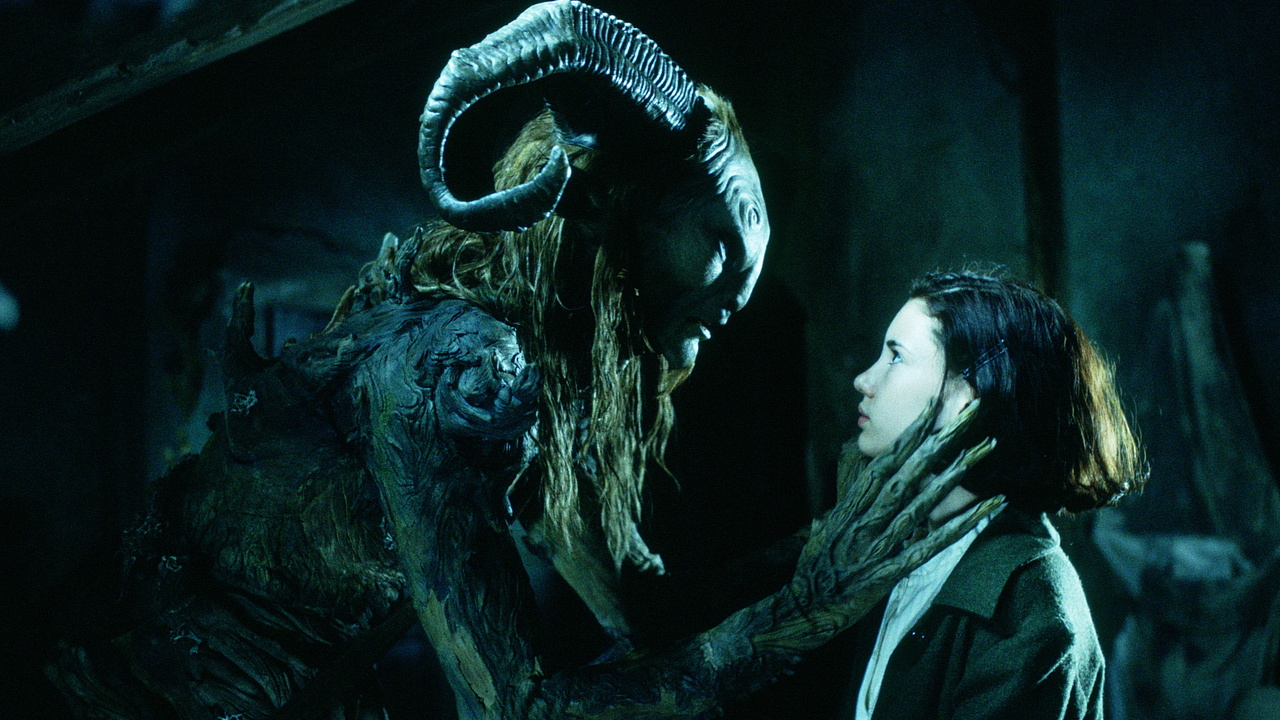
Everyone asks the wrong question about Pan’s Labyrinth.
The question everyone asks is: is the fantasy real?
Does Ofelia actually descend into a labyrinth beneath the earth? Does she actually meet a faun with curling horns and insect-eaten wood for skin? Does she actually face a toad inside a fig tree and a pale eyeless creature who eats children and a final test that costs her life? Or is she a traumatized girl in fascist Spain, inventing a fairy tale to survive a world that will not let her be a child?
Guillermo del Toro has answered this question in interviews. Both are real, he says. The fantasy and the history coexist. They are not alternatives. They are simultaneous.
But even del Toro’s answer, generous as it is, accepts the premise that “real” is what we should be asking about. And I want to set that premise aside entirely, because Pan’s Labyrinth is not interested in whether the fantasy is real. It is interested in what the fantasy does. And what it does is the most radical thing a story can do inside a system that demands obedience.
It disobeys.
Spain, 1944
The setting is not incidental. It is foundational.
Francoist Spain in 1944. The Civil War is over. Franco has won. The Republic is dead. In the mountains of northern Spain, the last fragments of the Republican resistance are hiding in the forests, conducting sabotage operations against military outposts. Captain Vidal, Ofelia’s new stepfather, has been assigned to crush them.
Vidal is one of cinema’s great monsters, and his monstrousness is not theatrical. It is procedural. Sergi López plays him as a man whose cruelty is entirely functional. He tortures because torture produces information. He kills because killing produces order. He repairs his father’s watch because time must be measured and controlled. He wants a son because the institution of patriarchy requires an heir. Every act of violence Vidal commits serves the system he represents. He is not sadistic. He is efficient. And efficiency in the service of fascism is a form of evil so pure it barely needs a face.
Del Toro understands something about fascism that many films set in this period do not. Fascism is not an aberration. It is an order. It has rules, schedules, hierarchies, uniforms, mealtimes. It is an institution in the fullest sense this series has explored: it renames you, it assigns you a role, it tells you the story of your life, and it punishes deviation with death.
Every institution this cycle has examined has demanded a version of obedience. The Overlook told Jack he’d always been the caretaker. The city in Chinatown operated beyond the reach of investigation. The network in Network turned rebellion into programming. Lee Woo-jin in Oldboy scripted the rebellion itself.
Vidal’s fascism is simpler and, for that reason, more absolute. There is no seduction, no bargain, no recruitment. There is only the rule and the punishment for breaking it. You obey or you die.
Into this world, del Toro places a girl with a book of fairy tales.
The Faun
Ofelia follows an insect into the labyrinth on her first night at the mill. The insect becomes a fairy. The fairy leads her underground. The faun is waiting.
He is ancient, cracked, slow-moving, somewhere between benevolent and dangerous. He tells Ofelia she is Princess Moanna, daughter of the King of the Underground Realm, and that she was born in the world below but escaped to the surface and forgot who she was. To return, she must complete three tasks before the full moon.
Notice the structure. It is the same structure as every institutional claim this series has examined. You are one of us. You have always been one of us. You forgot. The institution will restore you.
“You’ve always been the caretaker,” said Delbert Grady.
“You are Princess Moanna,” says the faun.
Del Toro is not unaware of this parallel. The faun’s claim on Ofelia mirrors the Overlook’s claim on Jack. The underground kingdom’s insistence that Ofelia belongs to it mirrors every institution that tells its subjects their true identity was always institutional. This is not an accident. This is the film’s most sophisticated move.
Because del Toro gives you every reason to distrust the faun, and then asks you to consider whether the distrusted story might still be the one worth living inside.
The Three Tasks
Each task is a test. Not of courage or cleverness, though both are required. Each task is a test of obedience.
The first task sends Ofelia into a fig tree to retrieve a golden key from inside a giant toad. The tree is dying. Its roots are rotting. The toad is a parasite that feeds on the tree from within. Ofelia must crawl through mud and rot and the insides of a decaying organism to reach the key.
The second task is the Pale Man’s banquet. Ofelia enters a room with a long table covered in food. At the head of the table sits a creature with no eyes, its eyeballs resting on a plate in front of its empty palms. The faun has told her: do not eat anything. The walls are covered in paintings of the Pale Man eating children. The food is beautiful. She eats two grapes.
The Pale Man wakes. He puts his eyes into the stigmata on his hands and raises them to see. He chases her. She barely escapes.
The third task is the final one. The faun tells Ofelia to bring her baby brother to the labyrinth. The portal to the underground kingdom requires the blood of an innocent. Just a few drops, the faun says.
Ofelia refuses.
This is the climax of the film, and it is the climax of this cycle’s argument.
The Refusal
Think about what Ofelia is refusing.
She is refusing the faun. She is refusing the underground kingdom. She is refusing the story that has sustained her through the horror of Vidal’s mill. She is refusing her identity as Princess Moanna. She is refusing the only narrative that has offered her agency, meaning, and escape from a world of absolute cruelty.
She is refusing because the story demands the blood of her brother.
This is where Pan’s Labyrinth separates itself from every film this cycle has examined. In every previous film, the question was whether the story traps you or frees you. In Mulholland Drive, the dream was a coffin. In Taxi Driver, the hero narrative was a loaded gun. In The Shining, the institutional story was a possession. In Oldboy, the revenge narrative was a cage built by the enemy.
Pan’s Labyrinth proposes a different question. Not whether the story is a trap, but whether you can live inside a story and still say no to it when it asks for too much.
Ofelia chose the fantasy. She descended into the labyrinth. She completed two tasks. She accepted the faun’s story about who she was. And at the moment when the story demanded something she could not give, she refused the story she had chosen.
This is not escape. This is not obedience. This is something the series has not encountered before: selective faith. The willingness to live inside a narrative while retaining the capacity to break with it. The ability to be Princess Moanna and also Ofelia. To accept the story without surrendering to it.
Danny Torrance survived the Overlook by stepping off the path. Chihiro survived the bathhouse by remembering her name. Both children refused the institution’s story. But both refusals were total: you reject the institution and you leave.
Ofelia doesn’t leave. She stays inside the story and disobeys from within. She is a believer who says no. And the distinction between leaving the story and disobeying inside it is the distinction Pan’s Labyrinth exists to make.
Vidal’s Story
Captain Vidal also lives inside a story.
His is simpler. His father was a military hero. His father smashed his watch at the moment of his death so that his son would know the exact time his father became eternal. Vidal carries this broken watch. He repairs it. He winds it. He keeps time.
Vidal’s story is: I am my father’s son. I serve the same cause. I will die the same way, at a moment of my choosing, and my son will carry the watch forward.
This is the fascist narrative at its most personal, and del Toro handles it with a precision that recalls The Godfather’s treatment of Michael Corleone. Vidal is not following orders. He is continuing a lineage. He is performing the role his father performed, in the uniform his father wore, in the service of the power his father served. The institution is not external to him. It is genealogical. It runs through his blood the way the faun’s story runs through Ofelia’s.
And here is the parallel that del Toro constructs: both Ofelia and Vidal are living inside inherited stories about who they are. Both are performing roles assigned by a previous generation. Both believe the story gives their actions meaning.
The difference is in what each story asks of them.
Vidal’s story asks him to torture, to kill, to crush the resistance, to produce an heir, to maintain the machine. The story’s demands escalate, but Vidal never hesitates, because the story never asks him to do anything that contradicts his power. Every act of violence confirms his identity. The story and the self are perfectly aligned, and the alignment is what makes him a monster.
Ofelia’s story asks her to crawl through mud, to resist temptation, and finally, to harm an innocent. And at that final demand, the story and the self diverge. Ofelia discovers that she is not simply a character in the faun’s narrative. She is a person who can evaluate the narrative’s demands against her own sense of what is right.
Vidal cannot do this. Vidal has no self apart from the story. There is no Captain Vidal who exists outside the fascist lineage. When the partisans capture him and he asks them to tell his son the time of his death, Mercedes says: “He won’t even know your name.”
The institution gave Vidal everything: identity, purpose, power. And when the institution falls, there is nothing left. Not even a name.
Ofelia loses the story too. She loses the kingdom, the crown, the identity of Princess Moanna. But she keeps the thing the story could not take: the refusal. The no. The choice to protect her brother even at the cost of everything the narrative promised her.
The institution gave Ofelia a story. She lived in it, drew strength from it, and broke with it when it asked for too much. The institution gave Vidal a story. He lived in it, drew strength from it, and could not exist without it.
That is the difference between a story that serves you and a story that owns you. And it is a difference you can only discover at the moment the story asks for blood.
Mercedes
There is a third storyteller in the film, and she is the one the audience often overlooks.
Mercedes is the housekeeper at the mill. She serves Vidal’s meals. She is quiet, efficient, invisible in the way that service workers are invisible to the people they serve. She is also a spy for the Republican resistance, smuggling supplies and information to the partisans in the mountains.
Mercedes lives inside no story at all. She has no fairy tale, no inherited lineage, no institutional identity. She has a brother in the mountains and a knife hidden in her apron. She survives not by constructing a counter-narrative but by operating in the gaps between other people’s stories. Vidal doesn’t see her because his story doesn’t include her. The faun doesn’t recruit her because she is not a princess. She exists in the space that narratives leave unattended.
And it is Mercedes who survives. Not through fantasy, not through obedience, not through disobedience, but through the practical, daily, unglamorous work of resistance. She feeds the partisans. She hides the medicine. She stabs Vidal in the face when he catches her, slicing his mouth open in a wound he will carry for the rest of his short life.
Del Toro gives the film three models of living under fascism. Vidal’s total identification with the institution’s story. Ofelia’s selective faith in a counter-story. Mercedes’ storytess pragmatism, the knife in the apron, the work that needs no narrative to justify it.
The film loves Ofelia. It mourns her. But it survives through Mercedes.
The Blood
Ofelia refuses to give the faun her brother’s blood. She stands in the labyrinth, holding the baby, and says no. Vidal finds her. He takes the baby. He shoots her.
Ofelia falls. Her blood drips into the labyrinth’s center. The portal opens.
And here is the image that del Toro has been building toward: the blood that opens the door is not the innocent’s blood. It is Ofelia’s. Her own blood, shed by the fascist’s gun, is what fulfills the task. The sacrifice the faun demanded was not the brother’s. It was hers. And she could not have offered it willingly, because willing self-sacrifice would have been another form of obedience. The sacrifice had to come from the outside, from the system’s violence, from the bullet Vidal was always going to fire.
This is the most complex proposition about narrative this series has encountered. The story Ofelia was told required innocent blood. She refused. And in refusing, she provided something the story could accept instead: her own life, taken by the institution she defied.
The disobedience was the task. The refusal was the answer. The story didn’t fail when she said no. It completed.
Is this real? Did Ofelia actually return to the underground kingdom? Del Toro shows it both ways. We see her dying on the stone floor of the labyrinth, and we see her arriving in a golden throne room, her father and mother waiting, the faun bowing. Both images are given equal weight. Both are presented without irony.
The question, as I said at the beginning, is wrong. The question is not whether the fantasy is real. The question is whether the refusal was worth it. Whether saying no to a story you love, at the cost of everything the story promised, is an act of surrender or the highest possible act of freedom.
Del Toro’s answer is visible in every frame of Ofelia’s death: in the gentleness of the light, in the music, in the tears on Mercedes’ face, in the flower that blooms on the dead fig tree in the film’s final shot.
The tree was dying. Something fed on it from within. A girl crawled inside and removed the parasite. And after she was gone, after the fascist’s bullet and the labyrinth’s blood and the story’s impossible completion, the tree flowered.
Where This Leads Us
Pan’s Labyrinth argues that a story can be both a construction and a lifeline, that you can live inside a narrative without being owned by it, that disobedience within the story is possible.
But there is another film that tests this proposition in a different way. It is set in another authoritarian state, behind another wall, under another system of total surveillance. It features a man whose job is to listen to other people’s stories. He is an agent of the state, trained to monitor, record, and report. He is the institution’s ear.
And the story he listens to changes him.
If Pan’s Labyrinth is about the storyteller who resists, the next film is about the listener who is transformed. If Ofelia builds a door out of narrative, this next film asks: what happens when the person guarding the door starts to hear the music on the other side?