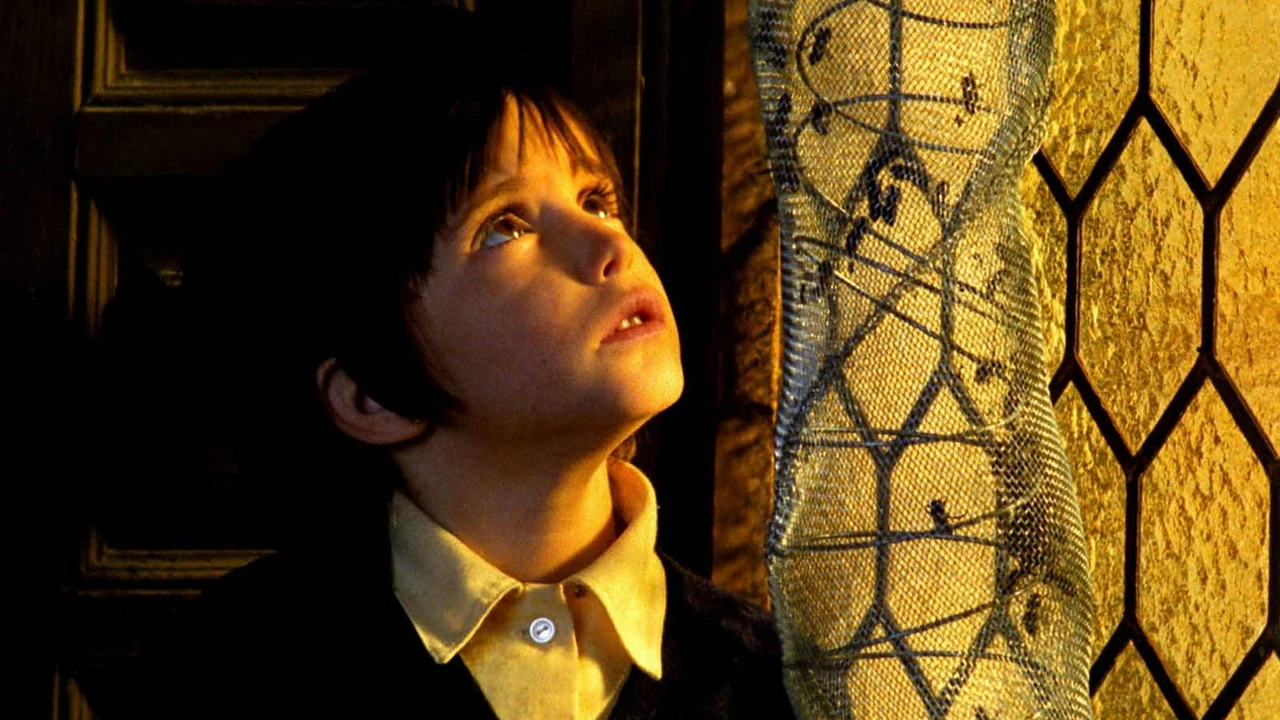
A Child Watches a Film in a Country That Has Stopped Speaking
A Dossier on The Spirit of the Beehive (Víctor Erice, 1973)
Why did the monster kill the little girl?
And why did they kill him?
These are the first important words spoken in the film, and they are spoken by a six-year-old, and nobody answers them.
Once upon a time — the film begins with these words, painted in a child’s handwriting over a child’s drawing, and then finishes the sentence with a specificity that fairy tales are not supposed to have — somewhere on the Castilian plain, around 1940.
That date is everything. 1940. The Spanish Civil War ended the year before. Franco’s Nationalists have won. The Republic is dead. The killing has stopped, mostly, but the silence that replaces it is not peace. It is the silence of a country that has brutalised itself — brother against brother, neighbour against neighbour — and now sits in the aftermath, unable or unwilling to speak about what it has done. The adults have entered a kind of waking coma. They move through their days. They tend their beehives. They write letters to people who may no longer exist. They eat dinner across from each other without exchanging a word. They are alive, but something in them has gone quiet, and they will not say what it is.
Into this silence, a travelling cinema arrives.
The truck rolls into the village of Hoyuelos across a landscape so flat and so vast that the horizon seems to exert a kind of gravitational pull — you feel the emptiness of the meseta before you understand it. The truck passes the symbol of the Falange. It stops. The villagers file in. The film is James Whale’s Frankenstein, 1931. A monster made of dead parts, brought to life by a man who wanted to play God, set loose in a world that immediately wants to destroy him.
Ana watches.
Ana Torrent was seven years old when she played Ana. Erice has said that he did not direct her in the conventional sense — he created situations and let her respond. What the camera captured was not a performance but something closer to a documentary record of a child encountering things she did not fully understand. The enormous dark eyes. The solemn, unblinking focus. The way she watches the screen during Frankenstein with an intensity that makes every adult reaction in the room seem shallow by comparison.
Children watch films differently from adults. An adult watches Frankenstein and sees genre, metaphor, craft — the neck bolts, the lightning, the pathos of Karloff’s performance. A child watches Frankenstein and sees a creature who did not ask to be made, who reaches out to a little girl because she is the first being that isn’t afraid of him, who is given a flower and doesn’t know what to do with it, and who — in a scene of such casual horror that it barely registers as horror — throws the girl into the water, because he thought she would float like the flowers.
Ana sees this. She does not have the tools to process it — she has no concept of metaphor, no framework for fictional violence, no understanding that the monster is Boris Karloff in makeup and the girl is an actress who went home afterward. What she has is the image, and the question: why?
Why did he kill her, if she was kind to him? Why did they kill him, if he didn’t understand what he was doing?
She asks her sister Isabel. Isabel, who is older by perhaps two years — old enough to have begun learning the adult art of not answering — tells her that the monster didn’t really die. He is a spirit. He lives in an abandoned sheepfold outside the village. You can find him if you go there. You can talk to him if you close your eyes and call to him.
This is a lie. It is also, in the logic of The Spirit of the Beehive, the most important truth in the film.
The film that follows is almost entirely silent.
Not literally — there is music, there are ambient sounds, there are occasional words. But the silence is structural. It is the silence of a family in which the father, Fernando, tends his bees and writes in his journal and never speaks to his wife about anything that matters. The silence of the mother, Teresa, who writes letters to someone whose name we never learn, addressing them to a place we never see, and who rides her bicycle to the train station to post them with a regularity that suggests ritual rather than communication. The silence of the village, where nothing seems to happen and yet the Guardia Civil are always present at the edges of the frame, the way they were always present at the edges of Spanish life under Franco.
Erice, born in 1940 — the same year the film is set — has spoken about this silence as the defining texture of his childhood. The adults around him, he said, were people who had lived through something so horrific that they chose not to speak about it. Children experienced this as “a form of absence.” The parents were there, physically. But deep down, they were far away.
“What characterises those people in my memory of my childhood is that they were in general very silent, introspective people. They didn’t want to speak because they had lived through something so horrific. We children experienced it as a form of absence.” — Víctor Erice
This is the unease that The Spirit of the Beehive produces, and it is unlike anything in the previous six dossiers. In Five Easy Pieces, the adults speak too much and say too little. In Caché, the adults speak strategically, editing their confessions. In Picnic at Hanging Rock, the landscape swallows language. Here, the adults have simply stopped. They are present and absent simultaneously, like bees behind glass — visible, purposeful, unreachable. And Ana, who needs them to explain the monster and the girl and the lake and the killing and the killing of the killing, receives nothing.
So she goes looking for the spirit herself.
What she finds, in the abandoned sheepfold, is not a spirit. It is a man.
He is a Republican fugitive — a soldier from the losing side, hiding from Franco’s police. He is wounded. He is exhausted. He is, in the visual language of the film, a monster: a creature who did not ask to be hunted, who is hiding in the place where Isabel said the spirit lives, who is as frightened of the world as Frankenstein’s creature was.
Ana brings him food. She brings him her father’s coat and her father’s pocket watch. She does this with the same unselfconscious generosity as the girl in Frankenstein offering the monster a flower. She does not understand what a Republican fugitive is. She does not understand the Civil War. She understands only that there is a being in the sheepfold who is alone and cold, and that she can help him, and that this feels right in a way that the silence of her house does not.
The Guardia Civil find him. They shoot him. Ana goes to the sheepfold and finds blood on the ground and the man gone. She finds her father’s coat and her father’s pocket watch, and she understands — without having the language for it — that the adults have done it again. The same thing the villagers did to the monster. Kindness, then death, and no one will explain why.
She runs. She runs into the flat, dark, enormous Castilian landscape, the same landscape that swallowed the girls in Picnic at Hanging Rock except that here it does not swallow — it simply extends, in every direction, offering no shelter and no boundary, until Ana collapses beside a river and the search parties find her and bring her home.
The film’s final image is the one that stays.
Ana stands at her bedroom window in the middle of the night. The window is open. She looks out into the darkness — the same darkness that lives at the edges of every frame in this film, the darkness of the meseta, of the beehive, of a country that has turned inward and shut its eyes. And she whispers, to the darkness, to the spirit, to whatever it is that lives outside the world the adults have made:
Soy Ana. I am Ana.
It is an act of identification so plain, so unadorned, so lacking in adult complexity that it becomes the most devastating moment in the film. She is not asking for the spirit to come to her. She is not performing a ritual. She is telling the darkness who she is — because no one else in this film has told her, because her parents are far away and her sister lies and the man in the sheepfold is dead and the monster on the screen was killed for reaching out and the country she lives in has decided that the safest thing is to say nothing, be nothing, want nothing.
I am Ana. The first and most radical act of resistance against a world that has stopped speaking: to speak your own name into the silence and wait.
The film does not show us what answers.
Víctor Erice made three feature films in his career. Three, across five decades. Franco’s censors saw The Spirit of the Beehive and were troubled by it — they sensed the allegory, smelled the critique — but they could not identify what, specifically, to cut. The film’s meaning lives in its silences, in the angle of light through honeycomb glass, in the duration of a child’s gaze, in the space between a question and the absence of an answer. You cannot censor silence. You cannot cut what was never said.
The censors let the film pass, reasoning that its slow pace and thin plot would ensure limited public attention. They were wrong. The film became the most celebrated work in Spanish cinema, the only Spanish film on Sight & Sound‘s list of the hundred greatest films of all time, and the seed from which Guillermo del Toro would grow The Devil’s Backbone and Pan’s Labyrinth — films that returned to the same question Ana asked in 1973, the question Spain spent forty years not answering: what happens to children who are raised inside a silence they cannot decode?
The answer, Erice suggests, is that they go looking for monsters. And the monsters they find are never as frightening as the silence they left behind.