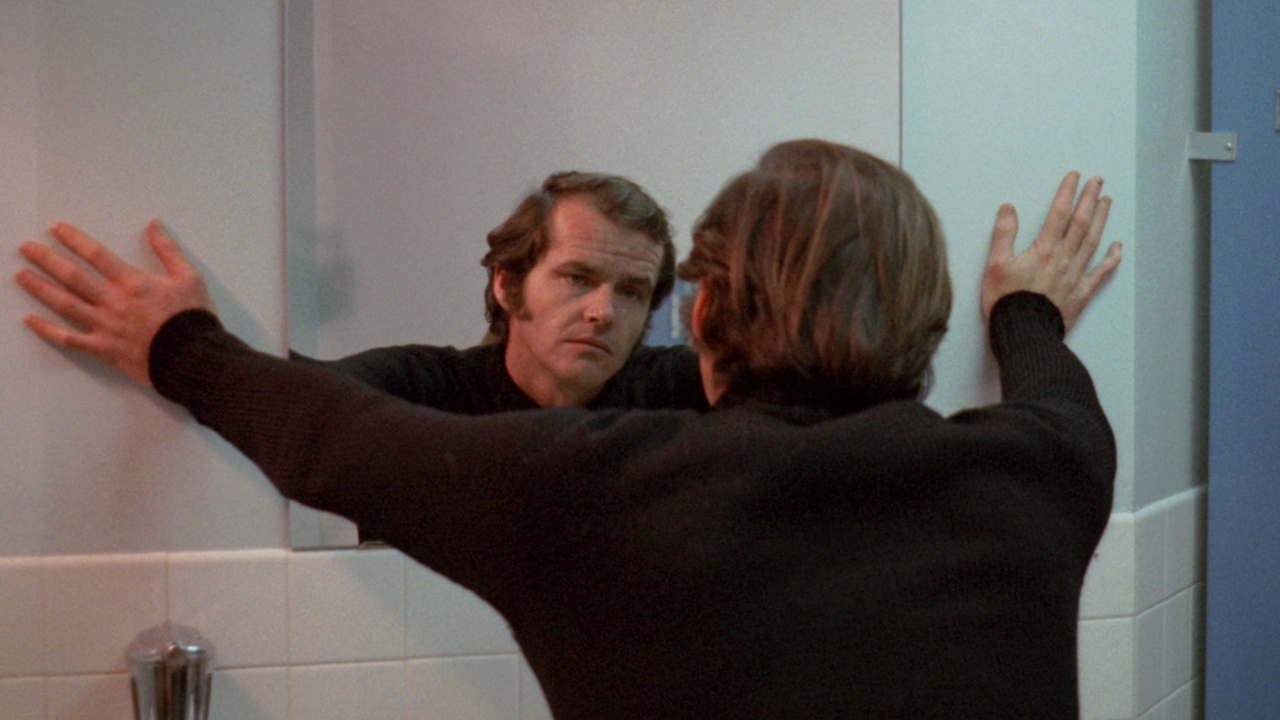
Bobby Dupea, the Mythology of Running Away, and the Film That Quietly Refuses to Believe Him
A Dossier on Five Easy Pieces (Bob Rafelson, 1970)
Everyone remembers the wrong scene.
Ask someone about Five Easy Pieces and they’ll tell you about the diner. Jack Nicholson, the chicken salad sandwich, the toast. It’s been absorbed into pop culture as a moment of cool, articulate rebellion — the little guy sticking it to the system, one inflexible waitress at a time. The scene has been quoted in a thousand listicles about cinema’s greatest moments. It has its own mythology.
But the film knows something the audience has collectively chosen to forget. Immediately after that diner showdown, as one of the hitchhikers in the back seat applauds Bobby for his defiance, he mutters a line that demolishes the entire performance: “But I didn’t get my toast, did I?”
That single line is the key to everything. Bobby Dupea didn’t win that exchange. He lost. And the film saw it, even if fifty-five years of audiences haven’t.
This is the deeper unease that Five Easy Pieces leaves behind. Not just that Bobby is lost — plenty of New Hollywood films gave us lost men — but that Bobby is the hero of a story he’s telling himself, and the film is too honest to agree with him.
• • •
Consider the story Bobby tells about himself. He is a man too sensitive, too talented, too restless for any single world. He comes from a family of classical musicians — his very middle name, Eroica, is Beethoven’s Third Symphony — but he has rejected that privilege. He works on oil rigs. He bowls. He drinks with men who would never recognise a Chopin prelude. The implication, as Bobby seems to understand it, is that he’s too authentic for the stifling refinement of the Dupea family and too intelligent for the honest simplicity of Bakersfield. He belongs nowhere because nowhere is good enough.
This is an immensely seductive self-narrative. It positions failure as a kind of integrity. It turns running away into a philosophical stance. And for decades, audiences bought it — partly because Jack Nicholson is so explosively charismatic in the role that you want to believe Bobby the way Bobby wants to believe Bobby.
“The irresponsible behavior does not exclude a clear feeling that Nicholson is touched and perplexed by people.” — David Thomson, critic
Thomson’s observation, from his essay for Criterion, is surgically precise. It identifies exactly why we fall for Bobby — Nicholson’s performance radiates genuine curiosity about the people around him, a warmth that flickers in and out, making us believe that deep down, Bobby is better than his actions suggest. But the film’s genius lies in how systematically it undercuts that belief without ever making a speech about it.
Watch what actually happens, scene by scene. Bobby cheats on his pregnant girlfriend. He berates her for singing along to Tammy Wynette. He picks fights he can’t win — literally, in the case of his father’s nurse, who subdues him effortlessly. He seduces his brother’s fiancée, Catherine, and when she is genuinely moved by his piano playing, he dismisses her emotion with breathtaking cruelty: he tells her he chose the easiest piece he could think of, that he played it better as a child, that there was no real feeling in it. Each of these moments is the act of a man who mistakes destruction for depth.
• • •
The piano scene with Catherine is where the film’s quiet refusal becomes unmistakable.
Bobby plays the Chopin Prelude in E minor — a piece of aching simplicity and emotional directness. Catherine is visibly moved. And Bobby, rather than accepting that connection, immediately dismantles it. Roger Ebert identified this as possibly the moment Bobby’s nerve fails and he condemns himself, consciously, to a life of self-defined failure. But there’s something even more troubling at work. Bobby isn’t just rejecting the music or Catherine’s response. He is rejecting the possibility that he might still be capable of genuine feeling. The mythology requires that he be beyond all that — too wounded, too knowing, too far gone. To admit that the Chopin moved him too would be to admit that his entire exile has been unnecessary.
Catherine sees through him. Her response is the most devastating line in the film — one of the most devastating in all of 1970s American cinema.
“If a person has no love for himself, no respect for himself, no love of his friends, family, work, something — how can he ask for love in return? Why should he ask for it?” — Catherine Van Ost (Susan Anspach), in Five Easy Pieces
This isn’t a lover’s rebuke. It’s a diagnosis. And the film positions it not as one character’s opinion but as something close to the truth. Catherine is the only person in the film who sees Bobby without his mythology, and what she sees is a man who has made a religion out of self-sabotage. When Bobby later asks her to leave with him, her refusal isn’t dramatic. It’s calm, considered, almost gentle. She has simply recognised what Bobby cannot: that he is not a romantic figure fleeing an unbearable world. He is a man who destroys every good thing he touches and calls it freedom.
• • •
Then there is Bobby’s confession to his silent, stroke-stricken father — the scene that cracks open everything the film has been holding in restraint.
“I move around a lot, not because I’m looking for anything really, but because I’m getting away from things that get bad if I stay.” — Bobby Dupea (Jack Nicholson), in Five Easy Pieces
This is Bobby at his most naked, and it’s the one moment where the mythology slips. He isn’t performing rebellion or playing the romantic outcast. He is admitting, to a man who cannot respond, that his entire life has been built on evasion. Not search. Not freedom. Evasion. The distinction is everything. Bob Rafelson, who conceived the story, later said he was writing about friends from college, some of whom were already dead — that what drew him to the material was self-destruction. That word, self-destruction, is what the mythology of Bobby Dupea is designed to obscure. If you call it restlessness, or authenticity, or refusal to compromise, it sounds almost noble. If you call it what it is — a man systematically dismantling his own life because he is too afraid to build anything — the romance collapses.
And the film collapses it. That’s the unease. Five Easy Pieces gives you every reason to love Bobby Dupea — the charisma, the intelligence, the flashes of tenderness — and then quietly, without announcement, shows you that loving Bobby is exactly the mistake Bobby wants you to make.
• • •
Two other currents of unease run beneath this central one, and they deserve mention because they deepen the discomfort rather than resolve it.
The first is the ending. Bobby and Rayette stop at a gas station on their way back to California. While she’s inside, Bobby hitches a ride on a logging truck headed north — to Alaska, to nowhere, to the next erasure of himself. He leaves without his jacket, without his wallet, without a word. The film presents this with no musical cue, no close-up designed to tell you what to feel. It is among the most disturbing final sequences in 1970s American cinema because it functions simultaneously as escape and as suicide — not literal, but existential. Bobby isn’t heading toward something. He is heading away from everything, including the last person who genuinely cares whether he’s alive. And the camera holds on the gas station long after the truck has disappeared, as if waiting for something that will never come back.
The second is Rayette. Karen Black’s performance is often discussed in terms of how it contrasts with Bobby — she’s simple where he’s complex, open where he’s closed, country where he’s classical. But Rayette is something more uncomfortable than a foil. She is the moral centre of a film that does not want to admit it has one. She is loyal, loving, pregnant, and consistently humiliated — by Bobby, by his family, by the film’s own narrative structure, which treats her as an obstacle Bobby must navigate. Yet she is the only character in the film who offers love without conditions and without performance. The unease she produces is this: if Rayette is the best person in the film, and the film barely notices, then what does that say about whose stories we find worth telling?
• • •
Five Easy Pieces is not a film about a man who can’t find himself. That’s Bobby’s version. The film’s version is darker: Bobby has found himself, and he can’t stand what he’s found. The sensitivity is real. The talent is real. The capacity for connection is real — we see it in the way Nicholson’s eyes soften around his father, in the tenderness that flickers and dies in the Chopin scene, in the way he defends Rayette against Samia Glavia’s snobbery even as he’s been privately treating Rayette far worse. Bobby Dupea is not empty. He is full of things he refuses to use.
That is the unease that fifty-five years haven’t dimmed. We know this man. We may, in our worst moments, be this man. And the film — lean, unsparing, devastatingly controlled — offers no way out. Not for Bobby. Not for us.