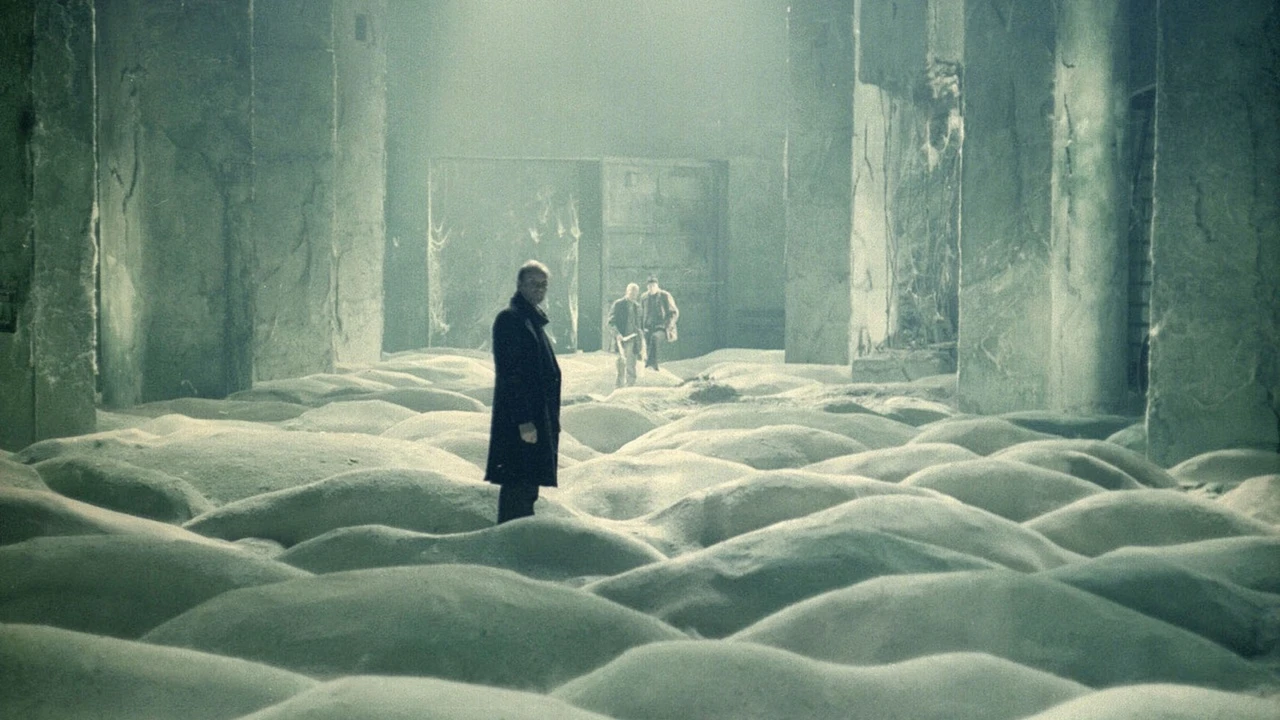
Three Men Walk Toward Everything They Want. None of Them Goes In.
A Dossier on Stalker (Andrei Tarkovsky, 1979)
THE DEPARTURE
The world outside the Zone is shot in sepia. Not the warm sepia of nostalgia but the dead sepia of exhaustion — industrial, damp, colourless. A man lies in bed with his wife and his daughter. A train passes. The room shakes. He gets up. He is going to the Zone again.
His wife begs him not to go. She has begged before. She knows what happens to the men who go. She knows what happened to Porcupine, the Stalker’s mentor, who entered the Room and wished for wealth and received it and hanged himself a week later. She knows that her daughter’s condition — the girl cannot walk, the girl may be something more than human — is a consequence of her husband’s exposure to the Zone. She begs, and he goes anyway, because leading people to the Room is not what the Stalker does for a living. It is what he does instead of living.
Two men are waiting for him in a bar. They are called the Writer and the Professor. We will never learn their real names. The Writer is cynical, alcoholic, and afraid that his talent has dried up. The Professor carries a rucksack. Inside the rucksack is a bomb. He does not mention this.
They set out.
THE THRESHOLD
The journey into the Zone begins with an act of transgression that Tarkovsky films with the deliberate weight of a border crossing in a dream. The three men ride a motorised railcar through a military blockade, shots fired behind them, searchlights raking the darkness. Then the sepia lifts. Colour bleeds into the image — greens so saturated they seem to hum, water so present it appears to breathe. The Zone.
For seven dossiers, Unspoken Cinema has examined films where something is withheld — an explanation, a resolution, an identity, a person. Bobby Dupea withholds himself from his own life. Llewyn Davis is locked in a loop that withholds a future. Burning withholds the answer to whether Ben is a monster or a mirror. Caché withholds the sender of the tapes. Mulholland Drive withholds the boundary between dream and waking. Picnic at Hanging Rock withholds the girls. The Spirit of the Beehive withholds every answer a child needs.
Stalker does something different. It withholds nothing. The Zone is open. The Room is real, or at least available — the Stalker has led people to it before and will lead people to it again. The door is right there. You can see it. You can walk through it.
The withholding, this time, comes from inside the men themselves.
THE PATH
The Zone does not behave like a landscape. It behaves like a consciousness.
Paths shift. Rooms that were dry fill with water between cuts. A telephone rings in an abandoned building and no one is on the line. The Stalker throws metal nuts tied to strips of cloth ahead of him to test the way — the Zone, he says, has traps, and the traps change, and the only safe passage is indirect. You cannot walk straight to the Room. You must approach it sideways, circuitously, with what the Stalker calls respect.
Tarkovsky shoots this journey in takes that last four, five, six minutes without a cut. The camera drifts over pools of water in which objects lie submerged — a syringe, coins, a religious icon, a rusted pistol, pages from a book. The water is shallow and still and contains a history the film will not explain. You are not watching a thriller. You are not watching science fiction. You are watching something closer to a prayer — long, repetitive, and structured around the faith that the repetition itself is the point.
The Writer does not believe any of this. He drinks. He mocks the Stalker’s reverence. He wanders off the path deliberately, daring the Zone to punish him. It doesn’t. Nothing happens. The Writer returns, unharmed, and the absence of consequence is more disturbing than any danger would have been — because it means either the traps don’t exist, or the Zone chose not to spring them, and both possibilities are equally unsettling.
The Professor says little. He adjusts his rucksack. He is thinking about the bomb.
THE ARGUMENT
In the centre of the Zone, in a flooded room one threshold from the Room itself, the three men sit and argue. This is the true heart of the film — not the Room but the argument about the Room, which is an argument about whether human beings can be trusted with their own desires.
The Writer’s position: the Room is useless because it grants your deepest wish, not the wish you’d choose. What if your deepest wish is something shameful? What if the thing buried at the bottom of your psyche — beneath the ambition, beneath the talent, beneath the performance of being a writer — is something banal, or monstrous, or both? Porcupine went into the Room wishing for his dead brother to come back to life. The Room granted his deepest wish instead: wealth. Porcupine discovered that the person he was at the core was not the grieving brother but the greedy man, and the knowledge killed him.
This is Bobby Dupea’s terror made explicit. Bobby spent his entire life running from the suspicion that he was less than his mythology suggested — that beneath the restlessness and the rebellion there was something ordinary and afraid. The Room is the place where that suspicion becomes certainty. It shows you the wish you didn’t know you had, and the wish is who you actually are, and who you actually are might be someone you can’t survive being.
The Professor’s position: the Room must be destroyed. Not because it doesn’t work but because it does — and because no human being can be trusted with a mechanism that reveals and fulfils the unconscious. The powerful will use it for domination. The weak will use it for destruction. The well-meaning will discover that their meaning was not as well as they believed.
The Stalker’s position: the Room is the only thing that gives people hope. Even if they don’t enter. Even if they stand at the threshold and turn back. The possibility of the Room — the knowledge that somewhere in the world there is a place that takes your deepest self seriously — is enough. To destroy it is to destroy the last remaining proof that the world has a structure that cares about human wanting.
THE THRESHOLD, AGAIN
They reach the Room.
It is not impressive. It is a flooded, debris-strewn chamber open to the sky. Sand dunes have formed on the floor, shaped by a wind that seems to come from nowhere. Water drips. Light falls through the ruined ceiling in shafts that move too slowly for weather.
They stand at the entrance. The Stalker tells them they may go in. They may speak their wish. The Room will hear them.
Nobody moves.
This is the scene that separates Stalker from every other film about a journey toward something. In every hero’s journey, in every quest narrative, in every road movie ever made, the destination is reached and something happens — a confrontation, a transformation, a revelation, a disappointment. The arrival is the story.
In Stalker, the arrival is the silence after the story. The three men stand at the threshold of everything they want, and they discover that wanting is not the same as being willing to receive. The Writer is afraid his wish will expose him. The Professor pulls out his bomb, and the Stalker wrestles him for it, weeping, because the Professor is trying to destroy the only thing the Stalker believes in. The bomb is disarmed. The pieces are thrown into the water. And still, nobody enters the Room.
They leave. They go back to the bar. The sepia returns. The colour drains. The journey is over, and the Room is still there, and nobody used it, and Tarkovsky holds on the image of the three men sitting in exhausted silence, and the film asks you — not the characters, you — whether you would have gone in.
THE WIFE
And then the film does something it has no right to do, and it changes everything.
The Stalker’s wife looks directly into the camera — the only character in the film to break the fourth wall — and speaks. She speaks about loving the Stalker, about choosing him despite knowing he would bring her sorrow, about the child born damaged because of his work, about the grief and the fear and the waiting. She says she would choose it all again. Not because the happiness outweighed the suffering but because the suffering itself was a form of being alive.
In a film of philosophical argument between three men who cannot stop talking about meaning, the wife — who has barely spoken, who has been left behind, who has waited — delivers the only statement that lands with the weight of truth. She is not searching for the Room. She does not need the Zone. She already knows her deepest wish. It is the man lying exhausted on the bed, and the daughter who cannot walk, and the life she chose, fully aware of what it would cost.
If Ana in The Spirit of the Beehive whispers her name into the darkness and waits for an answer, the Stalker’s wife speaks her love into the camera and does not wait. She is not asking. She is declaring. And the declaration is more frightening than the Room, because the Room offers the possibility of fulfilment at the price of self-knowledge. The wife has already paid the price. She chose with her eyes open. She would choose again.
THE DAUGHTER
The final image. The Stalker’s daughter, Monkey — the child who cannot walk, the child the Zone may have changed — sits at a table. She stares at three glasses. Slowly, without touching them, one of the glasses begins to move across the table. Then another. The camera holds. The glasses slide toward the edge. One falls. On the soundtrack, Beethoven’s “Ode to Joy” rises as a train passes and the apartment shakes.
The daughter is telekinetic. Or the vibration of the train moved the glasses. Or the Zone’s influence has leaked into the world outside and is now operating through the child. Or Tarkovsky, who distrusted explanations the way Haneke distrusts resolution, simply wanted the final image to be one of quiet, unexplained power emanating from the person everyone else in the film overlooked.
The men went to the Zone looking for meaning. The meaning was in the apartment. It was in the child they left behind. It was in the glasses moving across a table in the last light of the afternoon, while “Ode to Joy” swelled and a train shook the walls and the daughter sat perfectly still, her eyes as dark and unreadable as Ana Torrent’s in a village on the Castilian plain, watching something the adults couldn’t see.
The Room grants your deepest wish. The deepest wish, Tarkovsky seems to say, is not to enter the Room. It is to come home to the people who are waiting for you, and to find that in your absence, something miraculous has grown in the silence — something quiet, something patient, something that moves glasses without being touched and does not need to explain itself.
The Zone is still there. The Room is still open. The door has never been locked.
You could go in. You won’t.