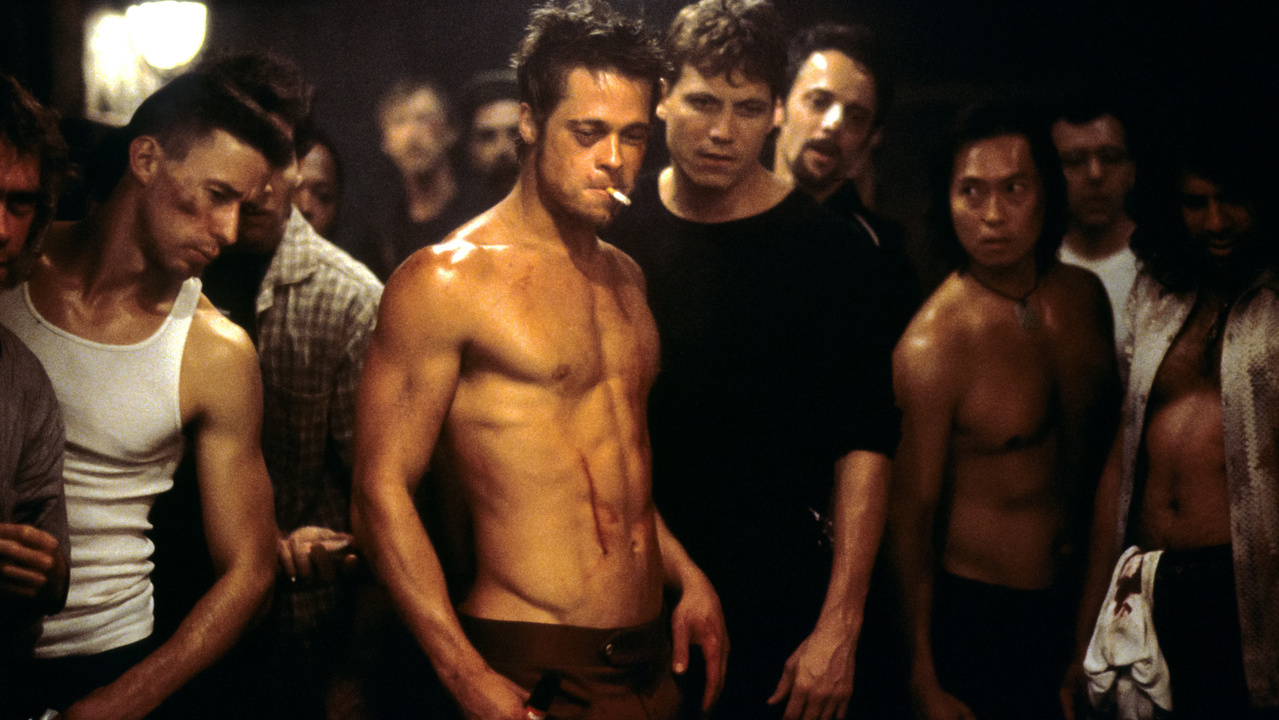
You own a Tyler Durden poster. Or you did, once. Maybe it was a t-shirt. Maybe it was a quote in your bio. Maybe it was just the feeling, the private conviction that you understood something other people didn’t. That you had seen through the machinery. That you were awake.
You weren’t.
And the film tried to tell you. It tried so hard. But you were too busy being seduced by the very thing it was warning you about, and that, more than any twist or any broken jaw, is the real story of Fight Club.
The Most Misunderstood Film of Its Generation
Here is a partial list of things Fight Club has been called since 1999: a manifesto for disaffected men, an anti-capitalist screed, a celebration of primal masculinity, a critique of consumer culture, a love letter to anarchy, a dangerous endorsement of violence.
Here is what Fight Club actually is: a film about a man who is so incapable of being real that he invents a version of himself who performs “realness,” and then worships that performance until it tries to kill him.
That’s it. That’s the whole movie.
Everything else, the soap, the fighting, the explosions, Project Mayhem, the abs, is set dressing around that single, devastating confession. And the confession is not: “Society made me sick.” The confession is: “I am so sick that even my rebellion is a fantasy.”
David Fincher knows this. Chuck Palahniuk knows this. The film knows this at every structural level. And a significant portion of its audience has spent twenty-five years not knowing it, which is either a failure of the film or its final, cruelest joke.
The Narrator Has No Name. That’s Not an Accident.
He is credited as “The Narrator.” In the script, he is sometimes called Jack, after the medical pamphlets he finds. (“I am Jack’s smirking revenge.”) But he has no name. Not in the film. Not in the novel. He is, by design, a blank.
And the blankness is the point.
Most readings of Fight Club begin with the Narrator’s consumer lifestyle. The IKEA catalog. The condo. The single-serving friends on airplanes. The film presents these things with such precise, acid contempt that it’s easy to take them as the diagnosis. This man is sick because he buys too much furniture. He is hollow because capitalism has hollowed him out. Smash the furniture, reject the system, find your primal self. Problem solved.
But the film is smarter than that.
Watch the early scenes again. The Narrator is not suffering because of his possessions. He is suffering because he has no interior life at all. The possessions are not the disease. They are the symptoms of an older, deeper vacancy. He furnishes his apartment the way you’d furnish a hotel room, not for comfort but as evidence that someone lives there. He buys things to prove he exists. The catalog isn’t capitalism’s tool of oppression. It’s his tool of self-construction.
He has no name because there is nothing to name.
When he can’t sleep, he starts attending support groups for diseases he doesn’t have. Testicular cancer. Tuberculosis. Brain parasites. He goes there to cry. He goes there to be held by a man named Bob who has lost his testicles to cancer and grown large breasts from the hormone therapy. He buries his face in Bob’s chest and weeps.
This is not a satire of support group culture, though it functions as one on the surface. This is a portrait of a man so emotionally starved that he can only access his own feelings by borrowing other people’s tragedies. He cannot cry for himself. He can only cry as a tourist in someone else’s suffering.
Remember this. It matters later.
Tyler Durden Is Not a Person. He’s a Product.
Brad Pitt’s Tyler Durden is one of the most iconic characters in modern cinema. He is cool, dangerous, funny, sexually liberated, philosophically provocative, and physically magnificent. He wears the perfect leather jacket. He says the perfect things. He has the perfect body.
He is, in other words, an advertisement.
The film tells you this. It tells you explicitly, in the twist, that Tyler is a projection. A hallucination. A brand identity created by a man who has no identity of his own. But even before the twist, the clues are everywhere. Tyler doesn’t talk like a person. He talks like a manifesto. Every sentence is a bumper sticker. “The things you own end up owning you.” “It’s only after we’ve lost everything that we’re free to do anything.” “You are not your job.”
These are not thoughts. They are slogans.
And slogans are the language of marketing.
The Narrator, drowning in consumer culture, does not escape it by creating Tyler Durden. He just creates a new product. A better product. A product called authenticity. A product called freedom. Tyler is the Narrator’s IKEA catalog for the soul. Sleeker. Edgier. But still a catalog. Still something to buy into. Still a surface to mistake for depth.
This is the irony that the film’s cult following has almost entirely refused to absorb. Every dorm room poster of Tyler Durden, every “first rule of Fight Club” joke, every man who watched this movie and thought “yes, I need to be more like Tyler” has done exactly what the Narrator did. They found a charismatic image and called it truth. They consumed the anti-consumption message. They bought the rebellion.
The product worked perfectly.
What Fight Club Actually Looks Like
Let’s slow down and talk about the fights.
Fincher films them beautifully. Of course he does. He is one of the most visually controlled directors alive, and he understands that the audience must be seduced before it can be implicated. The fights are primal, sweaty, ecstatic. The sound design is visceral. You can hear teeth on concrete. You can hear breath and impact and something that sounds almost like relief.
The men who fight describe it in terms that are unmistakably spiritual. They feel alive. They feel present. They feel, for the first time, real. And the film lets you feel it with them. It gives you the rush. It puts you in the basement. It lets you believe, for a while, that violence is a path to authenticity.
And then it shows you what that belief produces.
Project Mayhem.
The men shave their heads. They wear matching black clothes. They surrender their names. (“In death, a member of Project Mayhem has a name. His name is Robert Paulson.”) They follow orders without question. They carry out acts of escalating destruction. They recite Tyler’s words like scripture.
This is not rebellion. This is a cult.
It is also, in its aesthetics and its structure, fascism. The uniforms. The obedience. The charismatic leader. The mythology of violence as purification. The contempt for individual thought. The elevation of the collective body over the individual mind. Project Mayhem doesn’t just resemble fascist movements. It replicates their architecture with eerie precision.
And the film shows you this clearly. It does not hide it. Bob dies, a bullet through his head on a botched assignment, and his body is brought back to the house and the men stand around chanting his name, and the scene is not heroic. It is horrifying. It is a man reduced to a slogan in death, just as he was reduced to a slogan in life.
Fincher wants you to see the turn. He wants you to feel the exact moment when liberation becomes tyranny. And many viewers do feel it. But a remarkable number don’t. A remarkable number watch Project Mayhem and still think: this is cool. This is what men need. This is what the world needs.
The film predicted this, too. It predicted its own misreading. Because the Narrator himself is the first misreader. He created Tyler. He believed in Tyler. And by the time he realizes what Tyler actually is, the machine is already running and the bombs are already in the walls.
The Father Problem
“Our fathers were our models for God. If our fathers bailed, what does that tell you about God?”
Tyler says this to the Narrator. It’s one of the film’s most quoted lines, and like most of Tyler’s lines, it’s a slogan that conceals a wound.
Fight Club is, beneath everything, a film about fatherlessness. Not in the sentimental, after-school-special sense. In the structural sense. The Narrator’s father left when he was six. Tyler’s father left. The men who come to fight club are, implicitly and sometimes explicitly, men without fathers, without models, without anyone who taught them how to be men in a way that felt real.
And the film argues, quietly, that this absence is not filled by ideology. It is not filled by violence. It is not filled by Tyler Durden. It is filled, if it is filled at all, by something much smaller and less cinematic.
But the film can’t quite bring itself to say this directly. And that hesitation is its most interesting weakness.
Because for all its cynicism about masculinity, Fight Club is itself addicted to a very specific masculine energy. The camera loves Tyler’s body. The editing is aggressive, percussive, confrontational. The score pulses with the Dust Brothers’ industrial swagger. The film aestheticizes the very masculinity it claims to critique, and it knows it, and it does it anyway, because it is also, at some level, a film made by men who are working through the same hunger it diagnoses.
Fincher is not outside the problem. He is inside it. And the film is richer and more contradictory for that fact.
Marla Singer Is the Only Honest Person in This Movie
Nobody talks about Marla enough.
Helena Bonham Carter plays her as a walking disaster. Smeared makeup. A dying woman’s wardrobe. Cigarettes in cancer support groups. She is chaotic, selfish, sexually blunt, and entirely uninterested in performing for anyone.
She is also the only character in the film who is exactly who she appears to be.
The Narrator is a blank wearing a consumer identity. Tyler is a hallucination wearing a rebel identity. The men of fight club are lost boys wearing warrior identities. Everyone in this film is performing. Everyone is wearing a self.
Except Marla.
Marla doesn’t have a philosophy. She doesn’t have a manifesto. She doesn’t have a project. She is a woman in pain who copes badly and makes no apologies for it. When she fakes attendance at support groups, she does it for the same reason the Narrator does, to feel something, but she never pretends it’s anything more than what it is. She never builds a mythology around her dysfunction.
And the film punishes her for it.
Marla is shoved to the margins of a story that is ultimately about her. Because Fight Club is, beneath the noise, a love story. The Narrator’s real journey is not from consumer drone to enlightened rebel. It is from a man who cannot connect to a man who, in the final frame, takes a woman’s hand while the world explodes around them. Marla is the destination. She has always been the destination. And the entire Tyler Durden saga is an elaborate, destructive detour away from the terrifying simplicity of that fact.
The Narrator cannot simply love Marla. He cannot simply be vulnerable with another person. That would require an interiority he doesn’t have. So instead, he builds an empire of violence and philosophy, a massive masculine performance, to avoid the small, quiet, devastating act of being known by someone.
And when he finally shoots himself in the mouth to kill Tyler (the bullet passes through his cheek, not his brain, because the film, like its narrator, cannot fully commit to self-destruction), what’s left is not a hero. It’s a man standing in ruins, holding a woman’s hand, watching the towers fall. It is not triumph. It is the wreckage that remains when every performance has been exhausted and there is nothing left to do but stand there.
The Pixies play. The buildings collapse. The screen goes black.
It’s the most honest ending of any film in the 1990s. And almost nobody reads it that way.
The Film That Ate Itself
Here is the final irony, the one that crowns all the others.
Fight Club is a film about the impossibility of authentic rebellion within a system that absorbs and repackages every rebellion. Tyler Durden is the film’s illustration of this principle. He is rebellion as brand. Freedom as franchise.
And then Fight Club itself was absorbed and repackaged.
It became a brand. A franchise of attitude. A cultural signifier. Men quoted Tyler without irony. They printed his face on t-shirts manufactured in the same overseas factories the film implicitly critiques. “The first rule of Fight Club” became a punchline at corporate retreats. The anti-capitalist film grossed $100 million worldwide and sold tens of millions of DVDs.
The film predicted this. It had to. Because the entire logic of its narrative argues that there is no outside. There is no position from which you can critique consumer culture without being consumed by it. There is no authentic self waiting underneath the performance. There is only the performance, and then a different performance, and then another one after that.
This is what separates Fight Club from a simple anti-capitalist polemic. Polemics believe in a solution. Fight Club believes that belief in solutions is itself the problem. Every time you think you’ve escaped the system, you’ve just built a new, more interesting cage.
The Narrator learns this. Tyler is the cage he built to escape the first cage. Project Mayhem is the cage they built together. And blowing up the credit card buildings at the end is not liberation. It is another gesture. Another performance. The system will rebuild. The debt will be recalculated. The only thing that has actually changed is that the Narrator is standing next to Marla, and for one moment, just one, he is not performing.
That moment is the film’s only real act of rebellion. And it is so small, so quiet, so buried under explosions and Pixies songs and collapsing architecture, that almost everyone misses it.
The Connection You Weren’t Supposed to See
Truman Burbank walked through a door in the sky and the audience cheered and then changed the channel. The Narrator of Fight Club walked through every door he could find, broke every wall, blew up every building, and ended up standing in the same place: staring at the wreckage, holding another person’s hand, trying to figure out if this, finally, is real.
Both films are about men trapped in constructed realities. But The Truman Show believes there is something real on the other side of the wall. Fight Club does not. Fight Club argues that the wall is all there is. That every “real” you reach for is just another construction. That the best you can hope for is a moment of genuine contact with another person before the next performance begins.
Shawshank said: hope will set you free. The Truman Show said: freedom is terrifying. Fight Club says: freedom doesn’t exist. There is only the choice of which cage to live in, and the rare, fleeting grace of recognizing that you’re in one.
Three films. Three escapes. Three prisons. And the walls keep getting harder to see.
Where This Leads Us
Fight Club ends with buildings falling. A man and a woman silhouetted against the collapse. The strange calm of total destruction.
But what if the destruction isn’t metaphorical? What if the buildings actually fall? What if an entire nation watches it happen on television and the grief is real and the fear is real and yet, somehow, even the most genuine collective trauma becomes a performance? What if a film takes that trauma, that sincerely felt national wound, and turns it into the most elegant, the most seductive, the most morally sophisticated thriller ever made, and what if, in doing so, it reveals that even our darkest real-world moments are processed through narrative, through genre, through the machinery of storytelling?
What happens when the fight becomes real? And what happens to the stories we tell about it?