The Question the Body Asks
Here is a film with almost no plot.
A boy grows up in Miami. He is poor and Black and quiet and gay. He is raised by a mother who smokes crack. He is befriended by a drug dealer who teaches him to swim. He is kissed by a friend on a beach. He is beaten. He strikes back. He goes to prison. He comes out with muscles and gold teeth and a car and a hardened exterior that has almost nothing to do with who he is inside.
And then, years later, a man puts his hand on this man’s neck. And that’s the end.
If you describe Moonlight as a coming-of-age story, you’ve already missed it. Coming-of-age implies a destination. There is a world waiting for you, and you grow into it. You learn the rules, you fumble through adolescence, you emerge on the other side with a self. The genre assumes the self was always there, waiting to be discovered, and that society, however imperfectly, has a chair for you somewhere.
Moonlight has no chair. No destination. No world waiting with open arms. What it has instead is a body. And that body, across three chapters and three actors and roughly two decades, is trying to do something so simple it’s almost unbearable to watch: it is trying to become a body that can be touched without flinching.
That’s the whole film. That’s the entire revolution.
First Movement: The Body That Learns to Float
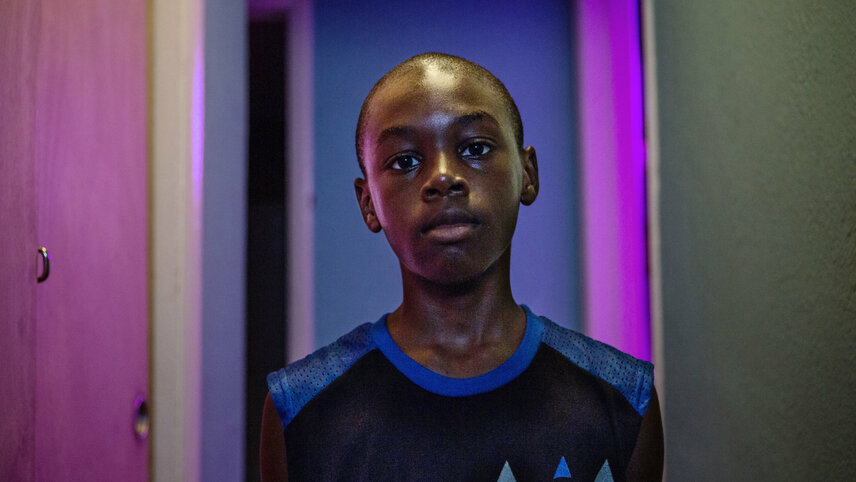
The first chapter is called “Little.” The name is literal. Chiron is small. Alex Hibbert plays him as a creature of compressed energy, a boy who has made himself as physically inconspicuous as possible because visibility means violence. He runs. He hides. He curls.
Watch how Jenkins films this child’s body. It is almost always in retreat. Shoulders turned inward. Head down. Occupying as little space as possible. This is a body that has already learned its first and most enduring lesson: presence is dangerous.
Then Juan finds him.
There is a scene in this first chapter that I believe is one of the most radical scenes in American cinema, and it involves no conflict, no revelation, no twist. Juan takes Little to the ocean and teaches him to swim. He holds the boy in the water. He supports his back. He tells him to let go.
That’s it.
But consider what’s actually happening. A Black man is holding a Black boy in water, and the water is holding them both, and for the first time in the film, the boy’s body is not clenched. It is not running. It is not curled into a corner of an abandoned apartment. It is floating. Supported. Weightless.
Jenkins shoots the scene in a way that strips it of everything except sensation. The light on the water. Juan’s hands beneath the boy. The boy’s face, open, terrified, then not terrified. For a few seconds, the body is free.
This is the scene Moonlight keeps returning to, not literally but structurally. The entire film is about whether this body can ever get back to this state. Whether the world will ever again hold Chiron the way the ocean held Little.
The answer, for most of the film, is no.
And that “no” is not a single event. It’s not one trauma, one rejection, one act of violence. It is systematic. It is architectural. It is the entire structure of Chiron’s world conspiring, not through malice alone but through the ordinary mechanics of poverty and masculinity and silence and racism, to make sure this body never floats again.
In our earlier look at Get Out, we traced how Jordan Peele mapped the architecture of racial violence onto a house, a suburb, a sunken place. The violence was structural. It was built into the floors. Moonlight does something related but different. Here, the violence is not a house. It’s not even a specific institution. It’s the air. It’s the water pressure that surrounds a body at every depth. There is no single architect. There is only the accumulated weight of a world that has decided this body should not exist as it is.
The Silence That Speaks Louder Than Dialogue
Here is something you might not notice until your second or third viewing: almost nothing important in Moonlight is said out loud.
No one says the word “gay.” No one names what is happening between Chiron and Kevin on that beach. Chiron’s mother never articulates what she’s doing to herself or to him. Juan never explains his own contradiction, dealing the drugs that are destroying the mother of the child he’s trying to save. The film is saturated with things that cannot be spoken.
This is not a flaw. It is the thesis.
Moonlight understands that the body speaks what the mouth cannot. Every important truth in this film is communicated physically. Juan’s hand under Little’s back in the water. Kevin’s shoulder touching Chiron’s shoulder on the beach. Paula’s jaw when she’s high, the way her body occupies the doorframe differently when she’s using versus when she’s clean. The bully Terrel’s posture, the way he moves through the schoolyard like he owns the geometry of it.
And silence, in Moonlight, is not the same as absence. It is presence under pressure. Chiron is not silent because he has nothing to say. He is silent because everything he has to say would make him a target. The gap between what the body knows and what the mouth is allowed to say is the space where the entire film lives.
This is the unspoken thing that most discussions of Moonlight glide past. Critics celebrated the film for its empathy, its beauty, its representation. All warranted. But the structural argument, the argument the film makes with its bones, is more uncomfortable: Moonlight is a film about what happens to a self when every avenue of expression is sealed shut except the body itself. And the body, denied every other outlet, becomes a text. It becomes the only record of everything the person has survived.
Second Movement: The Body That Learns to Disappear
The second chapter is called “Chiron.” He’s a teenager now, played by Ashton Sanders, and the body has changed. It is taller, thinner, angular. Still quiet. Still retreating.
But something has shifted. Little’s body was pre-linguistic. It hadn’t yet learned the full vocabulary of its own danger. Chiron’s body knows. It knows exactly what it costs to walk a certain way, to look a certain way, to hold a gaze a second too long.
This chapter contains the beach scene with Kevin, and it is the scene that breaks everything open and then, almost immediately, seals it shut again.
Two boys on a beach at night. One smokes. They talk, a little. Moonlight on water. And then Kevin touches Chiron, and Chiron lets him, and for a few minutes the body is back in the ocean with Juan. Floating. Held. Not performing. Not retreating. Just there.
Jenkins has talked about filming this scene with almost no artificial light, using the moonlight itself. The image is blue and dark and trembling. You can barely see the actors’ faces. And that’s the point. This can only happen in darkness. This can only happen outside every lit, surveilled, narrated space that Chiron occupies during the day. The body can only be honest when no one is watching.
What happens after is predictable and devastating. The schoolyard. Terrel forcing Kevin to hit Chiron. Kevin complying. Chiron’s body, the same body that floated in the ocean, that opened on the beach, absorbing the blows. And then Chiron walking back into school the next day and breaking a chair across Terrel’s back.
The violence is not catharsis. It is not empowerment. It is the moment the body decides to become something else entirely. It is the body choosing armor.
In Fight Club, we watched men build new bodies because their old ones felt fake. Tyler Durden promised that the body in pain was the body made real. That was the lie. But Moonlight shows the version of that lie that isn’t a choice. Chiron doesn’t choose armor the way the narrator chooses Fight Club. Chiron is beaten into it. The world doesn’t offer him the luxury of choosing his own destruction. It does it for him.
Third Movement: The Body That Arrives
The third chapter is called “Black.”
Look at him. Trevante Rhodes plays the adult Chiron, and the body is unrecognizable. Enormous arms. Gold grill. A car with a crown-shaped air freshener. He is a drug dealer in Atlanta now, the exact shape Juan occupied in Miami, and Jenkins is not subtle about the echo. He doesn’t need to be. The body tells the story.
This is a body built to never be touched again.
Every muscle is a wall. The grill is a mask. The car is a shell. The crown-shaped air freshener is the closest thing to tenderness this body allows itself, and even that is an echo of something lost. Black is what happens when a body that wanted to float in the ocean decides, after sufficient evidence, that floating is not survivable.
And here is where Moonlight does the thing that earns it a place in this series, and in the larger argument about what cinema can do.
Kevin calls. They haven’t spoken in years. Kevin is a cook now, in a small diner in Miami. He plays a song on the jukebox, “Hello Stranger” by Barbara Lewis, and it makes him think of Chiron, so he calls. Come eat, he says.
Chiron drives from Atlanta to Miami. That drive is the film’s longest pause. A body in transit. A body deciding whether to risk everything it built in order to feel something it felt once, briefly, on a beach, in the dark, a decade ago.
The dinner scene is extraordinary. Kevin cooks for Chiron. They sit across from each other. They talk, carefully, the way two people talk when every word could end whatever fragile thing is forming between them. And then they go back to Kevin’s apartment, and Kevin asks Chiron a question, and Chiron says the thing the film has been waiting three chapters to hear.
“You’re the only man that’s ever touched me.”
One sentence. Whispered. The body, the enormous, armored, gold-grilled body, stripped to its most vulnerable truth.
And then Kevin puts his hand on the back of Chiron’s neck. And in the final shot, we see Little again, standing on the beach, looking back at us, bathed in blue light.
The body arrives. Not at a destination the world prepared. Not at an identity category. Not at a triumphant coming-out. It arrives at the only place Moonlight ever promised: the place where one person’s hand on your skin doesn’t make you flinch.
The Film That Refuses Your Script
Part of what makes Moonlight so quietly devastating is everything it refuses to do.
There is no coming-out scene. No moment where Chiron declares himself. No confrontation where he tells his mother who he is and she either accepts or rejects him. The film understands that these scenes belong to a different narrative, one that assumes the infrastructure of acceptance exists somewhere, and that the drama lies in reaching it.
Chiron has no such infrastructure. He has no model for what he is. He has no language for it. He has Juan, briefly, who is tender but also complicit. He has Kevin, briefly, who is honest but also weak. He has his mother, who loves him in a way her addiction keeps corrupting. He has himself.
The refusal extends to genre. Moonlight is not a social-issues film. It does not explain racism or homophobia to the audience. It does not provide statistics. It does not climax in a courtroom or a protest or a speech. It trusts that the body on screen, if filmed with enough patience and enough intimacy, will communicate what no speech can.
This is where Moonlight intersects with Portrait of a Lady on Fire. Both films understand that the most radical thing cinema can do is look. Really look. Not narrate. Not explain. Just hold the gaze on a body and trust the audience to feel what that body feels. Héloïse and Marianne had each other’s gaze, reciprocal and sustaining. Chiron has almost no one’s gaze. When Kevin finally looks at him, really looks, it is like rain after a drought so long you forgot what weather was.
But Jenkins goes further than Sciamma. Portrait gave its lovers language. They quoted Orpheus. They debated art and memory. Chiron has no such luxury. The mutual gaze in Moonlight happens almost without words. It happens in the act of cooking and eating. It happens in the pause between sentences. It happens, most devastatingly, in a touch so simple it could be missed: a hand on the back of a neck.
The Institutional Architecture of the Unseen
There is a specific kind of violence in Moonlight that has nothing to do with the beatings, the bullying, the arrest.
It is the violence of not being seen.
Chiron moves through every institution in the film, school, the juvenile system, the drug trade, and none of them see him. They see a quiet kid. A troubled kid. An inmate. A dealer. They see the category. They never see the body inside the category, the body that floats in the ocean, that opens on the beach, that closes like a fist when the world demands it.
This is the deepest connection to Shoplifters, the film that ended Cycle Three and set the table for this one. Shoplifters showed a family that the institution refuses to recognize, a family built on acts rather than documents. Moonlight shows a self that the institution refuses to recognize, a self that exists in the body but has no document, no name, no category that fits.
Juan and Teresa are Chiron’s chosen family. Like Osamu and Nobuyo in Shoplifters, they exist outside the institution’s recognition. Juan is a drug dealer. Teresa is his girlfriend. There is no legal or biological claim. And yet the dinner table at Juan and Teresa’s apartment, where Little eats and is asked questions and is treated as a person, is the same table that Shoplifters placed at the center of its argument. The table that holds. The warmth that no document can authorize or revoke.
But Moonlight takes this further. Because Juan is also, simultaneously, the person selling drugs to Chiron’s mother. He is both the table and the thing that destroys the table. When Little asks Juan if he sells drugs, and then asks if his mother takes drugs, the silence that follows is the sound of every institution in the film collapsing into a single, unbearable contradiction.
The chosen family cannot save you when it is also, structurally, part of what is destroying you. Juan knows this. Watch Mahershala Ali’s face in that scene. It is the face of a man who has just been confronted with the fact that his tenderness and his livelihood are at war with each other, and that the body in front of him, this small, quiet, devastating child, is the battlefield.
The Ocean and the Armor
Water is the film’s central image, and it operates on two registers simultaneously.
The ocean is freedom. It is the space where the body floats, where gravity relents, where Juan’s hands hold Little and the world, briefly, becomes kind. Every time Chiron is near water, his body softens. Even in the third chapter, when Black is so armored he seems impenetrable, Jenkins gives us a shot of him washing his face, water running over that hardened exterior, and for a second you see Little underneath. Water is the solvent that dissolves the armor.
But water is also what the body is mostly made of. It’s inside you. You carry the ocean with you everywhere, and that means you carry the memory of floating everywhere, even when, especially when, the world is crushing you.
Jenkins said in an interview that the title comes from a phrase a character tells Little: “In moonlight, Black boys look blue.” It’s a line about seeing differently. About what light reveals when it’s not the harsh, fluorescent, institutional light of the classroom or the group home or the prison. Moonlight is the light that reveals what daylight hides.
And what it reveals is the body beneath the performance. The body that is not the muscles, not the grill, not the posture, not the swagger. The body that remembers floating. The body that, in the final scene, when a man’s hand rests on the back of its neck, finally exhales.
What This Film Knows That Critics Don’t Say
Moonlight won the Best Picture Oscar, in that chaotic envelope mix-up that briefly gave the award to La La Land. It was celebrated widely. It was called important. It was called beautiful. It was called necessary.
All of that is true, and none of it captures what the film actually does.
What Moonlight actually does is demonstrate, over three chapters and 111 minutes, that the distance between a person and their own body can be the longest distance in the world. That the project of an entire life can be the project of closing that distance. That for some people, the distance is imposed from the outside, by race, by poverty, by sexuality, by the interlocking systems that decide which bodies get to be soft and which have to be hard. And that closing the distance, when it happens, does not look like triumph. It does not look like a speech or a victory or a coming-out or an embrace. It looks like a hand on the back of a neck. It looks like a whispered sentence. It looks like a body that finally stops clenching.
In Mulholland Drive, we watched a self that could not survive the gap between who she was and who she needed to be. The dream collapsed and took Betty/Diane with it. Moonlight lives in that same gap, but where Mulholland Drive ended in annihilation, Moonlight ends in arrival. Small, quiet, terrifying arrival. The body does not triumph over its circumstances. It does not escape Miami or masculinity or poverty. It simply, after a lifetime of effort that the world will never fully see, becomes capable of receiving tenderness.
That is the revolution the film proposes. Not liberation. Not justice. Not representation, though it provides that too. The revolution is: a body, against all structural odds, learning to be touched.
The Cycle Begins Again
Cycle Four opens here. At the body.
Cycle Three ended at Shoplifters’ table, with the argument that what survives the collapse of every narrative is the act: feeding, holding, choosing each other. But the table assumes a body that can sit down. It assumes a body that can eat without flinching. It assumes a body that has already done the impossible work of arriving at a place where warmth is receivable.
Moonlight pulls the camera closer. What about the body itself? What has it survived? What has it been forced to become? What does it remember, in its muscles and its skin, that no narrative can capture?
This is the territory of Cycle Four. The body as text. The body as archive. The body as the thing that holds what language drops.
Where This Leads Us
Moonlight gives us a body that built armor to survive. A body that became someone else, physically, chemically, architecturally, in order to exist in a world that could not hold it as it was.
But there is another film about a body that builds armor. A film where the body is the performance, where the performance is the profession, and where the line between the body and the character it plays dissolves so completely that what’s left isn’t a person anymore but a wound performing the memory of a person.
The ring. The tights. The blood that is real even when the story is fake. A body that has given everything to its audience and has nothing left for itself.
The Wrestler (2008). Darren Aronofsky’s elegy for the body that the spectacle consumed. Where Moonlight asks what happens when the body builds armor, The Wrestler asks what happens when the armor is the body, and both are falling apart.