What Burning Shows You, What It Withholds, and Why You Can’t Stop Looking
A Dossier on Burning (Lee Chang-dong, 2018)
There is a scene in Burning where a young woman explains the art of mime. The trick, Hae-mi says, is not to imagine that something is there. The trick is to forget that something is not there.
Hold that thought. It is the key to everything in this film, and possibly to everything the film does to you.
THE EVIDENCE
Here is what we know. Jong-su is a young aspiring writer living near the border town of Paju. He reconnects with Hae-mi, a girl from his childhood neighbourhood. They sleep together. She leaves for Africa. She comes back with Ben — wealthy, charming, unknowable. The three of them form something that isn’t quite a love triangle because that would require all three sides to be visible, and in Burning, at least one side is always in shadow.
Hae-mi disappears. Her apartment is cleaned out. Her cat is in Ben’s house. Ben has a new girlfriend. Jong-su finds a pink watch — Hae-mi’s watch — in a box of women’s accessories in Ben’s bathroom.
Jong-su kills Ben. He burns the body.
These are the facts. They are also, possibly, not the facts at all. Because Burning is a film in which every piece of evidence is also, from a slightly different angle, evidence of something else entirely. And the unease it produces — the reason it lodges in the chest and stays there for days — is that the film will not tell you which angle is correct. Not because it’s playing a game with you. Because it doesn’t know either.
Lee Chang-dong, in interview, said something that should unsettle anyone looking for answers: he told Steven Yeun that he, the director, did not fully understand the character of Ben. He gave Yeun the responsibility of knowing who Ben was. The director of the film does not know if his character is a murderer.
This is not ambiguity as a stylistic choice. This is ambiguity as a condition of existence.
HAE-MI: The Woman Who Wanted to Disappear
Before she vanishes from the film, Hae-mi tells Jong-su about the Bushmen of the Kalahari. They recognise two kinds of hunger, she says. Little Hunger is the hunger of the body — for food, for shelter, for survival. Great Hunger is the hunger of the soul — for meaning, for purpose, for an answer to the question of why we are alive at all.
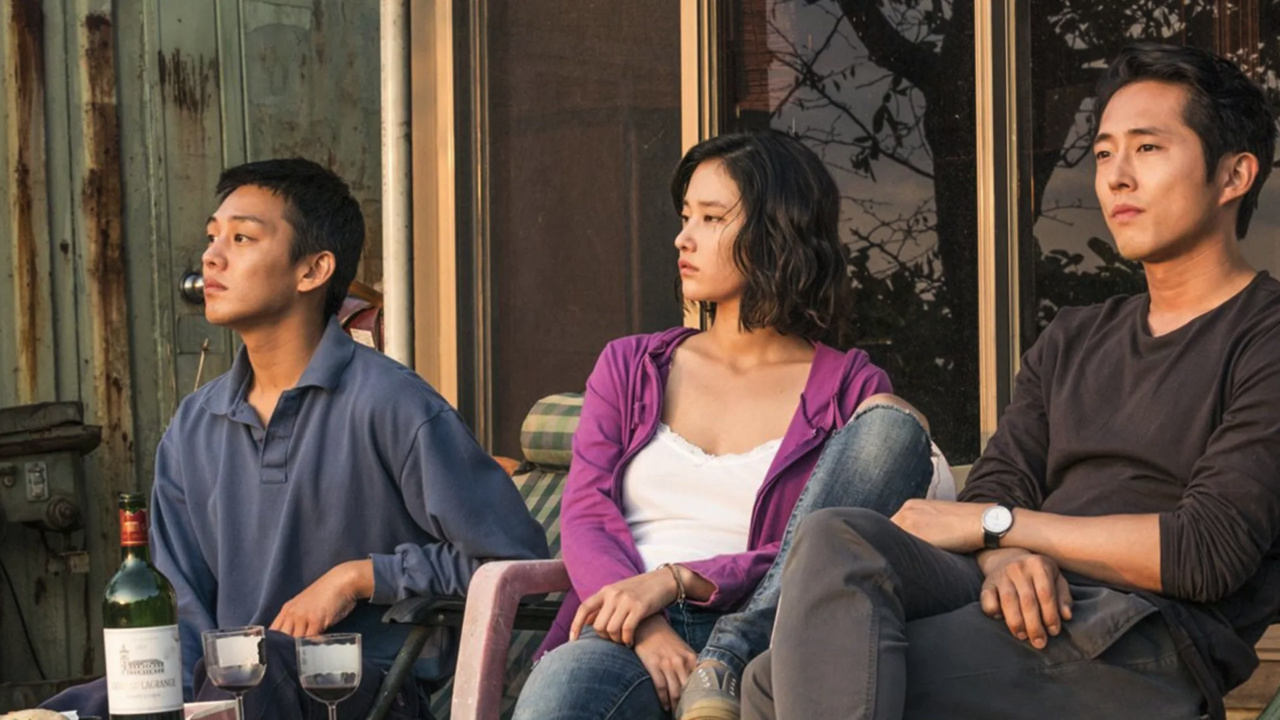
Hae-mi is consumed by Great Hunger. She eats invisible tangerines through mime. She travels to Africa to witness a ritual. She dances topless at sunset with her arms raised to a sky that is turning from gold to violet, and the dance is simultaneously the most beautiful and the most exposed moment in the film — a woman offering herself completely to the meaning of life, while two men watch her and understand nothing.
Lee Chang-dong identified this sunset scene as the most important in the film. He set it at dusk deliberately — between day and night, between truth and lies, between the real and the false. Hae-mi dances on the border, quite literally. Jong-su’s farm is near the North Korean frontier. You can hear the propaganda broadcasts. The South Korean flag hangs limp behind her. She dances between two countries, two men, two versions of reality, and the light is dying, and Miles Davis plays from Ben’s Porsche, and then a cow bellows from somewhere offscreen and the spell breaks and Hae-mi begins to cry.
And Jong-su calls her a whore.
This is the moment — not Hae-mi’s disappearance, not the murder, not the greenhouse confession — this is the moment where the film’s deepest unease lives. Hae-mi has just performed the most vulnerable act in the entire story. She has danced her Great Hunger for the meaning of existence. And the man she trusts most in the world responds with the most reductive word he can find.
The film is asking: is this what happens to women who seek meaning in a world built by men who can’t recognise it?
Hae-mi told Jong-su early in the film that she wondered what it would be like to disappear — as if she had never existed. Most readings treat this as foreshadowing. But what if it’s something else? What if Hae-mi is the one character in the film who understands her own situation clearly, and the two men — the one who might kill her and the one who will avenge her — are both equally blind to who she actually is?
BEN: The Greenhouse That May Be Empty
Ben yawns. This is the detail that haunts.
He yawns at parties. He yawns during conversations. He yawns in the presence of beauty and wealth and ease, surrounded by friends who laugh at Hae-mi behind her back. Steven Yeun plays the yawn not as rudeness but as a symptom — of something missing, some cavity at the centre of a life that has everything and feels nothing.
Ben tells Jong-su that he has never cried. Not once in his life. He has never felt sadness. He describes his work as “play.” He tells Jong-su about his hobby: he burns greenhouses. Abandoned, useless greenhouses, scattered across the Korean countryside. He burns one every two months. Nobody notices. Nobody cares.
“When I first met Steven Yeun, within thirty minutes I realised that Steven understood Ben even better than I did.” — Lee Chang-dong
The greenhouses are, of course, the film’s central metaphor — and like all metaphors in Burning, they defer meaning rather than deliver it. If the greenhouses are women, Ben is a serial killer. If the greenhouses are greenhouses, Ben is an eccentric rich man with a strange hobby. The film gives you evidence for both readings. The box of women’s accessories. The cat. The cleaned apartment. The new girlfriend who appears with the eerie smoothness of a replacement. And against all of that: Ben’s openness. He tells Jong-su about the burning. What kind of serial killer confesses his method to the man most likely to notice the next victim’s absence?
Unless that’s the point. Unless the confession is the thrill. Unless Ben, bored past the point of feeling, is playing a game in which the only remaining pleasure is watching someone try to figure out what you’ve done — and not being sure yourself whether what you’ve done is what they think you’ve done.
Lee Chang-dong described the film as being about rage — specifically, the rage of young people who sense that something is deeply wrong with the world but cannot identify what. Ben is the inverse: a young man for whom nothing is wrong, and the emptiness of that is its own kind of violence. He has so much wealth he doesn’t know what to do with it. He has so little feeling he has to set things on fire to know he’s alive.
Or he’s just a rich guy who burns greenhouses.
The film will not tell you.
JONG-SU: The Writer Who Cannot Write
Here is the question nobody asks about Burning, because the film has so expertly directed our attention toward Ben and Hae-mi that Jong-su — the character through whose eyes we see everything — slips past unexamined.
Jong-su wants to be a writer. He has not written anything. His father is in prison for assault. His mother abandoned the family when he was young. He lives alone on a failing farm near the border, tending a cow, feeding a cat he’s not sure exists. When he finally begins to write, it is only after Hae-mi’s disappearance — as if her absence is the first thing that has ever made him feel enough to put words on a page.
Lee Chang-dong, who was a novelist before he became a filmmaker, has said that by the film’s end, the question shifts from “Who is Ben?” to “Who is Jong-su?” This is the pivot the dossier turns on, because it reframes everything.
We have been watching the film through Jong-su’s eyes. His suspicions have become our suspicions. His evidence has become our evidence. When he finds Hae-mi’s watch in Ben’s bathroom, we feel the same cold certainty he feels. When the cat responds to the name Boil, we are as convinced as he is.
But Jong-su is not a reliable witness. He is a man who called a woman a whore for dancing. He is a man whose father is in prison for violent rage. He is a man who, by the film’s end, strips naked in the snow and stabs another man to death and burns the body — performing his own ritual, his own Great Hunger, his own version of what Ben may or may not have done.
The film’s final images show Jong-su driving away, naked, bloody, weeping. Lee Chang-dong holds on this long enough for the question to form: has Jong-su solved a murder, or has he committed one? Has he avenged Hae-mi, or has he destroyed the last remaining connection to her? Is this justice, or is this the rage his father passed down to him, finally finding its object?
And beneath even that: is what we just watched something that happened, or is it the novel Jong-su has finally written?
THE WELL
There is one more thing. It is small, and it is everything.
Early in the film, Hae-mi tells Jong-su that when she was a child, she fell into a well near their neighbourhood, and that Jong-su was the one who found her and pulled her out. Jong-su has no memory of this. He asks Hae-mi’s family. They say there was never a well. He asks the neighbours. They say the same. His own mother — distant, unreliable — is the only one who remembers a well.
The well may have existed. The well may not have existed. Hae-mi may be telling the truth about a formative childhood memory. She may be constructing a bond with Jong-su that was never there — performing, through narrative, the connection she desperately wants to feel.
This is Burning in miniature. An event that may or may not have happened. A story that may or may not be true. A connection that may or may not be real. And two people standing over the place where the well either was or wasn’t, looking down into something they can’t see the bottom of.
The trick is not to imagine that something is there. The trick is to forget that something is not there.
Lee Chang-dong has said he has no answers to the film’s questions, and that he isn’t hiding anything. This is, paradoxically, the most unsettling thing a filmmaker can say. A puzzle you can’t solve is frustrating. A puzzle that was never designed to have a solution is something else — something closer to the condition of being alive in a world full of greenhouses that may or may not be burning, people who may or may not be what they seem, and wells that may or may not have ever existed.
Burning does not ask you to solve it. It asks you to stand at the edge and look down.