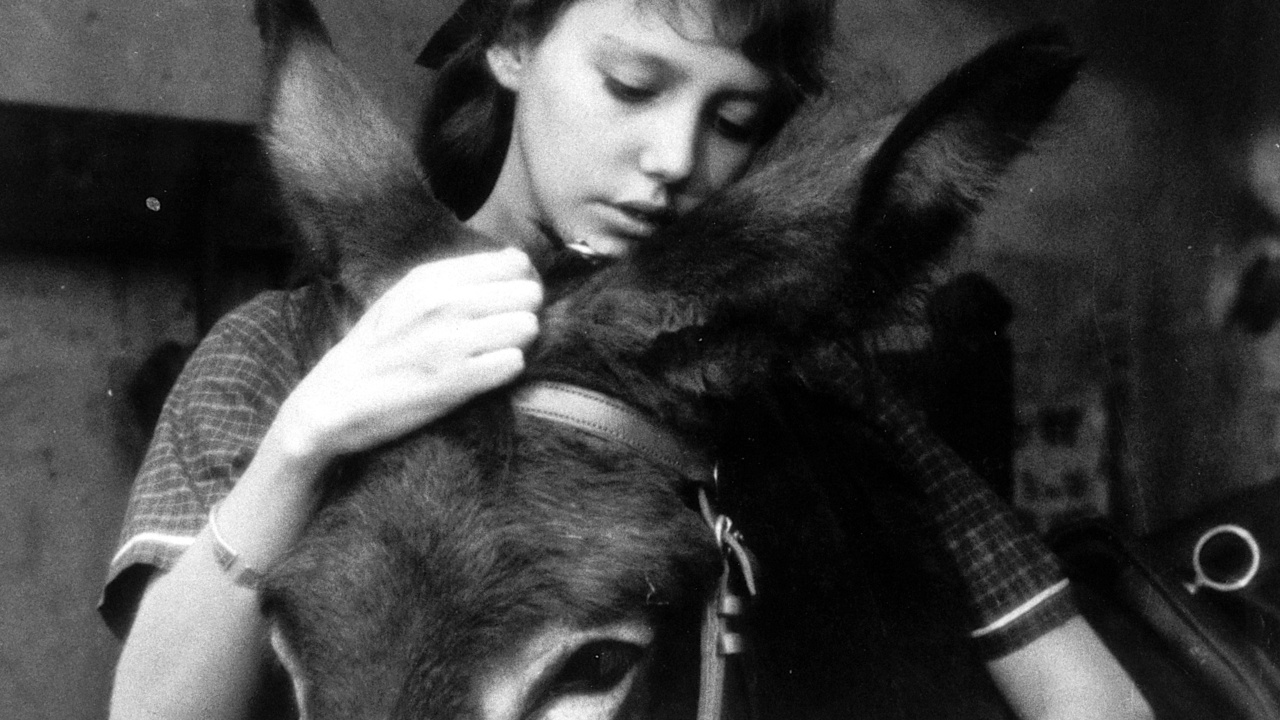
A donkey is born. Children baptize it with water from a cup, playing at ceremony. They name it Balthazar. They love it the way children love: completely, temporarily, with no understanding that love requires maintenance.
The children grow up. The donkey is passed from owner to owner. Each owner uses the donkey for something. Some are kind. Some are not. The donkey does not distinguish. It cannot. It receives kindness and cruelty through the same body, with the same silence, and the silence is not stoicism. It is not dignity. It is the absence of the apparatus required to turn experience into story.
The donkey suffers. The donkey does not know it suffers.
That gap, between the suffering and the not-knowing, is where this film lives, and it is where the film will put you, and you will find it almost impossible to breathe there.
Bresson does not use actors. He uses what he calls “models.” People who do not perform emotions but simply execute actions. They open doors. They hand over money. They hit an animal. They say words in a flat, uninflected tone that strips every sentence of the dramatic emphasis you rely on to know what to feel. Bresson removes the instructions. He removes the score that tells you this is sad, the close-up that tells you this matters, the reaction shot that tells you how to react. He gives you the event and nothing else.
You will find this unbearable. Not difficult. Not challenging in the way that film students use the word challenging, meaning interesting. Unbearable. Because without the apparatus of drama, you are left alone with the event, and the event is a man hitting a donkey, and there is no music to transform the hitting into meaning, and the absence of meaning is the meaning, and you will sit there and feel something that conventional cinema has been protecting you from your entire life: the raw, unprocessed, unnarratable weight of pain that simply happens.
Every film in this series until now has given suffering a context.
Watanabe’s suffering had a cause and a cure. Travis Henderson’s had a confession. Flyora’s had history. Even Come and See, which refused to redeem suffering, at least located it inside a narrative of war and survival and national memory. The suffering had coordinates. You could place it on a map.
Balthazar’s suffering has no coordinates. It is not caused by ideology or cruelty or even indifference. It is caused by the simple fact that the donkey exists in a world that contains humans, and humans use things, and the donkey is a thing, and the using is not malicious. It is ordinary. It is the way a farmer uses a plough. The way a boy uses a stick. The way a world uses a body that cannot say no.
There is a scene. I will describe it plainly because Bresson would want it described plainly.
Gérard, a young man who is casually cruel in the way that certain young men are casually cruel, ties a burning newspaper to Balthazar’s tail. The donkey runs. Gérard watches. He is not a villain. He is bored. The cruelty is recreational, which means it is the kind of cruelty that does not announce itself, does not appear in court, does not leave evidence that can be examined by a system designed to identify and punish cruelty. It is the cruelty of someone who does not think of what he is doing as cruelty, because the thing he is doing it to does not scream in a language he recognises.
You have witnessed this cruelty. Not this specific act. But its structure. The casual application of power to something that cannot resist. You may have performed it. Not to an animal, perhaps. To a situation. To a person who couldn’t push back. To yourself, even, in moments when you treated your own body or your own time with the same absent, recreational disregard.
Bresson doesn’t ask you to condemn Gérard. Condemnation would require Gérard to be exceptional, and Gérard is not exceptional. Gérard is ordinary. That is far worse than exceptional. Exceptional cruelty can be identified and removed. Ordinary cruelty is structural. It is the weather.
Marie loves the donkey when she is a child. She strokes its ears. She whispers to it. Then she grows up and her life becomes complicated in the ways that human lives become complicated, involving men and money and pride and the slow erosion of the softness she had at seven, and the donkey passes out of her care and into other hands, and she does not notice, because she is busy being a person, and being a person requires a kind of self-absorption that has no room for the things you loved when your love was unconditional and therefore unsustainable.
This is not a criticism. Bresson does not criticise. He observes. And the observation is: we love purely only when we are too young to understand what love costs, and when we are old enough to understand the cost, we can no longer afford the purity, and the things we loved purely, the donkeys and the summers and the friendships that asked nothing, pass out of our hands and into the world, and the world is not gentle with them.
Balthazar dies in a field surrounded by sheep.
He has been shot. Not dramatically. Not in an act of cruelty that the narrative has been building toward. He is shot because he is in the wrong place, carrying contraband he doesn’t know he’s carrying, serving a purpose he doesn’t understand for people who don’t care about him, and the bullet finds him the way weather finds a field: without intention, without meaning, without the courtesy of a reason.
He lies down. The sheep gather around him. Their bells ring. The light is soft, the kind of light that would be called beautiful in a film that permitted beauty to be a consolation, and Bresson permits no such thing, and the beauty exists anyway, and the beauty and the dying happen in the same frame, and neither one comments on the other.
You will cry. I want to say something about this, because it matters.
You will not cry the way you cried during Tokyo Story or Eternal Sunshine. Those tears had a narrative. They were located inside a story you understood, about people whose choices you recognised, and the crying was a form of recognition: I see myself in this, and the seeing hurts. The tears you cry for Balthazar have no narrative. They are not about recognition. You do not see yourself in the donkey. You cannot. The donkey has no self to see yourself in.
You cry because the suffering is real and the suffering has no story and the absence of a story means there is nothing between you and the suffering. No interpretation. No meaning. No lesson. Just a body in a field, and bells, and the soft light, and the fact that this body was used and used and used until it stopped, and nobody will write its history, and nobody will learn from its pain, and the pain existed anyway, fully, without witness, without language, without the consolation of being understood.
Most suffering in the world is this kind. Unwitnessed. Unnarrated. Without a filmmaker to frame it or a viewer to cry at it. Bresson knew this. He made a film about a donkey because a donkey is the purest form of this knowledge: a creature that experiences everything and understands nothing and cannot convert its pain into meaning and therefore carries the pain whole, undiluted, in a body that will never know why.
After the film, you will notice something.
It will not be dramatic. It will not feel like a transformation. You will simply find that your attention has shifted, slightly, downward. Toward the things that don’t narrate. The dog waiting outside a shop. The sound a chair makes when someone pushes it back too hard. The way objects accumulate wear. You will notice the world’s surfaces in a way you didn’t before, and the noticing will carry a faint charge, not quite sadness, not quite tenderness, something unnamed that Bresson understood and refused to name because naming it would have made it manageable and he wanted it to stay unmanageable.
The charge fades. Everything fades. But for a day or two, you will be living slightly closer to the world’s texture, the way Taste of Cherry brought you closer to taste and The Mirror brought you closer to memory. Except this closeness is not sweet. It is not warm. It is simply close. The distance between you and things that cannot speak has been reduced, and in that reduced distance, you will hear something that is not a sound but functions like one.
Bells. In a field. Getting quieter.
You will not know what they mean. Balthazar didn’t either.
That’s the point.